

Breakfast Briefing recap (Feb 2026) | Execution, trust, clarity and the habits that turn intent into impact
Most organisations don’t have a strategy problem. They have an execution problem.
That was the key takeaway from IMI’s first Breakfast Briefing of the year, where the expert panel explored why momentum stalls even when the insight is strong, the plan seems clear on paper, and digital/AI agendas appear to be advancing. Yet execution breaks down when trust, clarity and organisational habits break down.
The execution gap is not one thing. It’s a “perfect storm.”
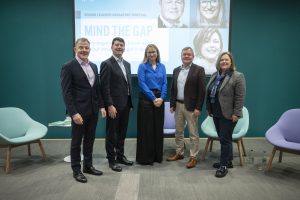
Gillian French framed the execution gap as a convergence of forces rather than a single root cause. From her exposure to high-growth businesses (including Datalex, CarTrawler and Cubic Telecom) and extensive people research, Gillian highlighted several trends that are making it harder for organisations to convert strategy into sustained action:
- Trust is eroding and leadership often overestimates it. The consequence is predictable: when people don’t trust the message, they won’t mobilise behind the plan.
- Anxiety is rising fuelled by headlines about AI, job losses and uncertainty. Organisations may be saying “get excited,” while employees privately wonder if the strategy is aimed at replacing them.
- Change fatigue is real with a growing resistance to “another initiative,” especially when people don’t see progress or payoff.
- Burnout is at record levels and showing up earlier in careers. Exhausted organisations don’t execute well; they cope, comply, and conserve energy.
- Leadership depth is under pressure — a hyper-change environment combined with leaders who can be “title-rich and experience-low” creates a fragile context for execution.
Under Gillian’s diagnosis, execution fails when the conditions for belief and energy aren’t present.
Execution accelerates when leaders reduce complexity into meaning
Fergus Barry, formerly group head of HR with Kirby, brought a “coalface” lens from mission-critical, project-centric environments where action is non-negotiable. He argued that a lot of burnout is driven by the over-acceptance of complexity, and a central job of leadership is to translate complexity into meaning and priorities that people can actually act on.
He returned repeatedly to a few practical disciplines:
- Distil the strategy into simple, operational truth.
People move faster when they can see the hill in front of them. - Start from the customer and work backwards.
The “reality check” is whether you are creating value. If not, activity becomes theatre. - Connect the strategy to the work right down to the individual level.
He emphasised the “boring” basics: mapping what is required from the executive team, through units and managers, to individual contributions. The point isn’t bureaucracy; it creates alignment. - Beware fake execution systems.
“Fake performance management” and “fake strategy mapping” create motion without real progress. Execution requires diligence rather than slogans. - Execution begins at the top.
His reminder that companies rot from the executive team landed because it’s often true: misalignment at the top multiplies ambiguity everywhere else.
One of the strongest moments was the contrast between programmatic change (“we’ll change in three months’ time”) and change that starts today. He linked this to the idea of the ambidextrous organisation: the best organisations “grind out today’s numbers while reinventing the future.” People regain energy when they see progress now, not just plans.
The psychological foundations: clarity, trust and psychological safety
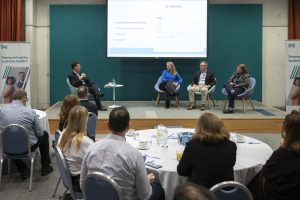
Anna Connolly, Programme Director for IMI’s Professional Diploma in Organisational Behaviour translated execution into human terms: people can’t execute what they don’t understand, and they can’t sustain change in an environment that doesn’t support the behaviours required.
Her message had three pillars:
- Clarity: Do people actually know the strategy? More importantly, do they know how their day-to-day work connects to it? Clarity reduces stress because it reduces “not knowing,” which instead leads to role confusion, shifting priorities and unclear goals.
- Trust: Trust isn’t something leaders “build” in the abstract; it’s something they earn through behaviour. A memorable definition surfaced: trust as a “confident relationship with the unknown.” In volatile conditions, that confidence comes from consistent communication, honesty, and follow-through.
- Psychological safety: Anxiety is present across organisations, and execution depends on whether people can surface concerns, challenge assumptions and offer ideas without fear. Where people don’t feel safe to speak, problems stay hidden….until they become crises.
Anna also added an important nuance: execution isn’t only about knowing the goal. It’s about whether the environment supports the behaviour and whether people have the motivation to sustain it.
AI: the opportunity isn’t the tool; it’s redesigning work for humans
AI came up as both a pressure and an opportunity. Gillian argued many organisations want AI “now” without clarity on what they want it to do. The deeper issue is that AI exposes a long-ignored weakness—job design.
She argued we need to return to basics:
- Redesign roles so people spend more time using their strengths and less time on tasks that drain value and energy.
- Remove needless friction (forms, compliance overhead, “low-human” work) so humans can do the human work.
- Get more creative about flexibility and work design rather than defaulting to blunt instruments like mandates or redundancies.
The message: if you design work well, engagement rises and productivity tends to take care of itself.
Scaling and “span of control”: the discipline to say no
On scaling into new markets, Fergus offered a hard-earned guardrail: span of control. Growth isn’t just opportunity; it’s execution risk. The discipline is being willing to say no to work you can’t deliver with confidence because overreach destroys trust with customers and burns out teams.
The practical playbook he described combined:
- clarity on core capability (what value do we bring here?),
- local readiness (legal, employment, stakeholder realities),
- and values-led decisions about what not to take on.
Acquisitions, burnout, and what public and private can learn
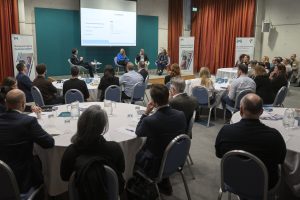
Questions from the room reinforced that execution challenges intensify during transitions—especially acquisitions and integration. Gillian mentioned a learning Zoom’s acquisition of Workvivo: don’t dismantle what’s working in the rush to “merge.” Sometimes execution is protected by preserving autonomy, leadership continuity and what made the business successful in the first place.
Burnout also sparked candid discussion, including why it appears earlier and can disproportionately impact younger women. Beyond social pressures and pace of change, an additional risk factor was noted called “purpose-driven overwork,” where high purpose becomes a pressure multiplier.
Finally, on public vs private sector: the panel observed that the human dynamics are similar, but the public sector carries greater complexity of stakeholders and oversight, which makes clarity harder and tolerance for non-leadership more costly. A recurring lesson for any system under complexity: execution improves when leaders are enabled—and expected—to lead with courage, and when organisations learn to say no.
What leaders can do next week: five execution levers
- Test strategy clarity: Ask five people at different levels to explain the strategy and how their work connects to it. Compare answers.
- Reduce complexity into priorities: Translate “everything” into the few moves that matter now and name the trade-offs.
- Build trust with truth: Communicate what you know, what you don’t, and what you’re deciding next. Consistency beats polish.
- Design work for energy: Identify tasks that energise vs drain; redesign roles to increase strengths-use and reduce pointless load.
- Shift from programmatic change to today’s change: Define the one behaviour shift you will start this week and measure it.
Execution isn’t a motivational problem. It’s a design problem: of clarity, trust, environment and habits. Close the gap there, and strategy finally turns into impact.
Go deeper
Many of the challenges discussed — change fatigue, stalled decisions, overload, and “initiative drift” — ultimately show up as behavioural patterns and organisational design issues. Building execution capability means being able to diagnose and shift those patterns, not just set new targets.
That’s exactly why IMI’s Professional Diploma in Organisational Behaviour exists. Rather than learning another framework, it’s about building the leadership habits that close the gap: creating clarity when priorities blur, earning trust when uncertainty is high, and shaping team routines that turn good intent into visible progress.
If you recognised your organisation in the conversation — lots of activity, but not enough traction — then the question becomes how do we make execution easier for people to do, and harder to drift away from? If you want to build that capability in yourself — or across a group of leaders — the diploma gives you a practical toolkit to take back into Monday morning.