


Moving. Poignant. Violent. Heartbreaking.
These are not words commonly used to describe business-focused keynotes, especially those dealing with high performance, AI and the unrelenting pace of modern work.
But Ronan Harrington’s recent IMI Masterclass around Resilient High-Performance was no ordinary session.
He opened with a joke about the narrowing gap between the last coffee of the day and the first drink of the evening. It got a laugh because it was all too recognisable. Many leaders in the room are coping by pushing through the day and calling that “normal”.
Ronan was direct about what he thinks is broken in modern work: the work keeps expanding, coordination keeps multiplying and leaders end up living inside a constant stream of requests. By the end the room was quiet for a different reason. He shared a personal story that explained why he speaks about resilience with such urgency. Out of respect for Ronan, we are not repeating the details here. It was about grief and health. It wasn’t offered as content. It was offered as a warning, and that was the most important takeaway for leaders from the session.
Here are six more takeaways from Ronan’s Resilient High-Performance Playbook.
1. Endurance gets rewarded. Resilience gets delayed.
One of the sharpest distinctions Ronan made was between endurance and resilience.
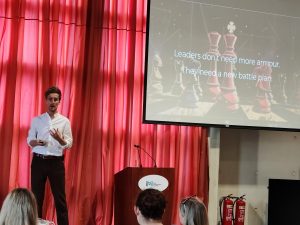
Endurance is pushing through. Resilience is adapting. Endurance works for bursts — launches, crises, quarter-end—but resilience must work for a career. It’s more intelligent. It’s the ability to adapt the plan when the conditions change rather than simply absorbing more impact.
In Ronan’s terms: leaders don’t need more armour; they need a new battle plan.
Yet a lot of organisations treat endurance as proof of commitment. People who stay available, say yes, and absorb pressure get noticed. Over time that becomes the model for “high performance”. The cost doesn’t always show up as immediate collapse. It often shows up as slower decisions, more rework, and a feeling that the organisation is busy without moving.
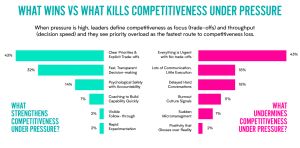
That matches what IMI’s Leadership Pulse has been picking up: under pressure, leaders describe competitiveness as something shaped by day-to-day operating conditions, not the strategy document. When everything becomes urgent, prioritisation breaks down and execution slows. The Pulse language about “value leaking” through rework and burnout risk is a useful shorthand because it keeps the conversation on delivery, not virtue.
2. The cadence: peak exertion, then renewal
One practical idea that landed well was Ronan’s insistence that resilient performance has a cadence. Not “balance” in the abstract, but a deliberate rhythm: push hard in a defined window, then recover on purpose.
He used simple examples leaders will recognise: teams can sprint toward a deadline or quarter-end, but without a planned “cool-down” the sprint becomes the default, and the organisation starts living in chronic acceleration. At that point, the symptoms show up exactly as you’d expect: decision fatigue, more rework and a steady drop in focus and judgement.
The point wasn’t to slow organisations down. It was to protect throughput. Peak effort works when it is time-bound and followed by renewal. Renewal is what makes the next peak possible.
For leaders, this means asking, where in our operating rhythm do we expect renewal to happen?
If the answer is “somehow, later,” it usually means it won’t happen at all, and the system will borrow against people until performance starts to degrade.
IMI Pulse Report
3. Burnout is not mysterious
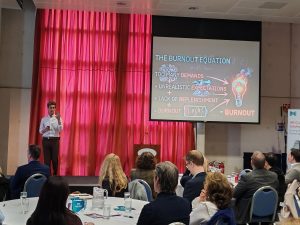
Ronan believes burnout follows a simple equation: too many demands, unrealistic expectations, and not enough replenishment. He pushed hard on the expectation part. Some expectations come from the organisation. Many come from the stories leaders carry about being competent, being reliable and not being seen as the bottleneck.
He didn’t spend time on obvious advice. Sleep matters. Movement matters. Everyone knows that, said Ronan. His point was that basic habits don’t fix a system that keeps pulling leaders into overload.
Two ideas made that clear.
First, “boss mode”: the loop of being needed, responding fast, clearing tasks and staying in motion. It can feel good. It can look like value. It can also be a way of avoiding harder work.
Second, “productivity dysmorphia”: doing a lot and still feeling behind. The day ends, the list is still there, and the body stays keyed up. Without a deliberate stop, work bleeds into home.
That’s why “wellbeing” messaging often bounces off senior leaders. It can feel like one more demand delivered in the wrong register. Ronan kept bringing it back to a more senior-leader frame: this is not just self-care; it’s performance, capacity, and risk.
4. The workday is split in two
The real problem with modern knowledge is that it’s designed to feel urgent, according to Ronan. Meetings, messages, follow-ups, alignment checks, status updates, constant interruptions. When that expands, deep work gets squeezed. People spend the day “aligning” and then try to “deliver” at night.
Even when people aren’t working outrageous hours, that structure has an effect. It pushes leaders toward reactive productivity, whereby leaders start “mowing the lawn”. They focus on reactive tasks to keep the backlog from looking frightening. It reduces anxiety in the moment. But it’s also a way of avoiding the hardest work: prioritising, making trade-offs, and doing the cognitively demanding tasks that actually move the organisation.
Alongside the Pulse survey, as part of an in-room survey taken on the day we asked leaders what breakdown looks like first. The symptoms people selected were operational: meetings multiplying without decisions landing, decisions landing without clear ownership, cross-team dependencies stalling work, and priorities shifting mid-week, forcing rework. Different labels, same underlying problem.
5. AI doesn’t automatically create capacity
Ronan didn’t do the usual “AI will save us” slide. Instead he described how time savings often disappear inside the system.
Even when AI speeds up tasks, people still spend time checking, correcting and reworking. And the remaining “saved time” tends to get absorbed by the next set of tasks. The system doesn’t automatically convert efficiency into capacity. Instead, efficiency turns into higher expectations unless leaders choose a different outcome for the time.
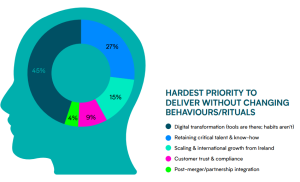
The Pulse finding that “tools are there; habits aren’t” fits here. AI can speed up tasks. It doesn’t automatically improve prioritisation, decision quality or focus. Those are leadership choices, and this is why resilient performance has become such a crucial leadership issue. If the organisation doesn’t explicitly decide what saved time is for — better thinking, better decisions, better recovery, better relationships — then it will be spent without anyone noticing.
IMI Pulse Report
6.What people asked for was not inspiration
The most telling question in the live poll was about support. When leaders were asked what would help close the execution gap over the next 6–12 months, the top asks weren’t inspiration or theory. They were tools and operating support: diagnostics, scorecards, facilitation guides, benchmarks of what “good” looks like, and practical ways to remove friction in how work gets done. Because most organisations don’t need more awareness, instead they need a way of operating that makes priorities clearer, decisions faster and focus possible. Doing fewer initiatives but ensuring the successful completion of those initiatives was also cited as key to improving outcomes.
That is where Ronan’s playbook really landed.
He returned to a small set of practices: keep a clear line of sight from strategy to weekly work; pick a small number of outcomes that must move; make them visible; use one-to-ones to focus people, free them from the wrong work, and understand what is going on; protect time for deep work before calendars fill; build renewal into the week rather than hoping it appears.
He also named the real barrier: saying no. Saying no is not a negative personality trait. It is a crucial leadership skill. The organisations that keep functioning under pressure aren’t the ones that never disappoint anyone. They’re the ones that can disappoint strategically, with clarity, and still keep relationships intact.
A note on the ending
Although we’ve agreed not to go into detail here, Ronan’s personal story changed the temperature in the room because it made the human cost real. It reinforced a point that had been building all morning: if leaders do not protect health and capacity in real time, the body eventually forces the issue later.
It also sharpened the purpose of the “operating system” idea. Resilient high performance is not about feeling good. It is about staying able to think, decide, and lead when the pressure does not ease.
Which is why the line that stuck with many attendees is so simple:
The work isn’t done, but it’s time to stop.
Not because leaders don’t care. Because stopping is part of how you keep leading.