

Former Taoiseach questions Ireland’s infrastructure pipeline and reflects on political leadership, diminishing capital and knowing when it is time to leave office. This follows part one of Rewiring Ireland, in which Sean O’Driscoll argued that Ireland must reform the machinery of government and change how the public system approaches risk. Part two examined what capable institutions need to plan, coordinate and deliver together.
Former Taoiseach Leo Varadkar has questioned whether Ireland has enough major projects ready to follow MetroLink, warning that improving delivery will not be sufficient unless the State also develops a credible long-term pipeline.
Varadkar identified Ireland’s infrastructure deficit as the country’s greatest immediate challenge and argued that housing, transport, climate and other quality-of-life issues must be addressed while the State has the financial capacity to do so.
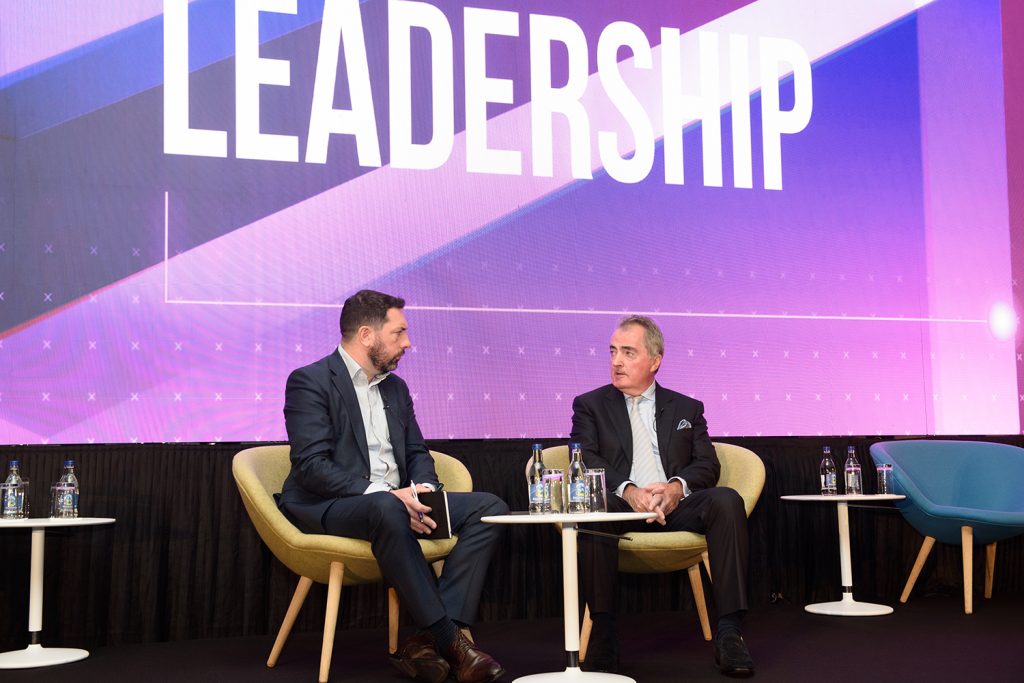
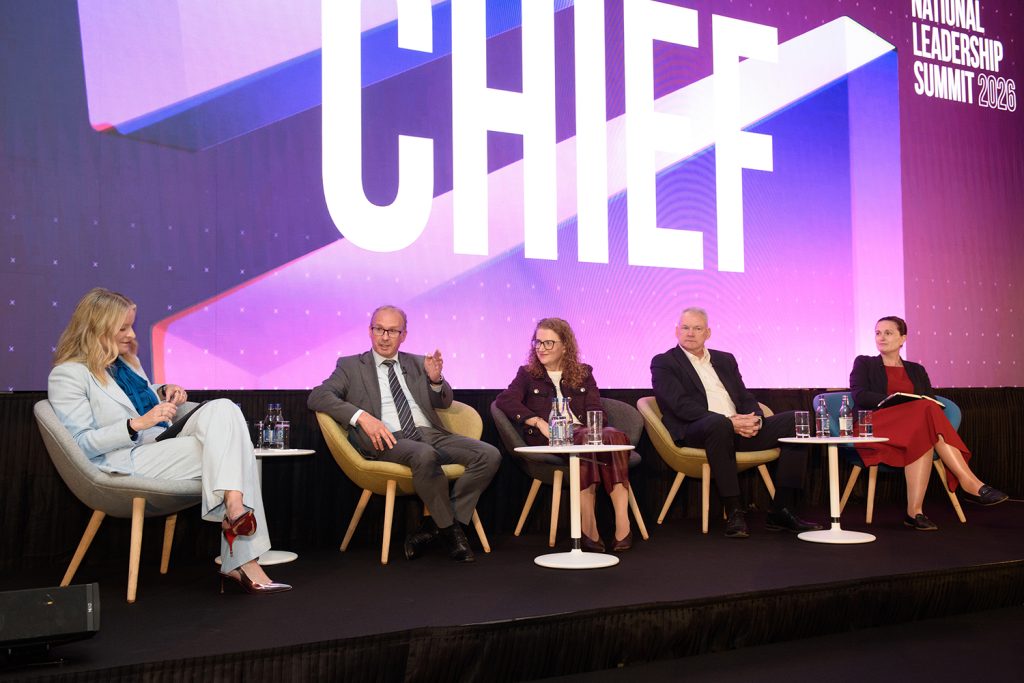
Speaking at IMI’s National Leadership Summit, he questioned what major transport, health or university development would follow the projects already under way.
In a wide-ranging discussion, Varadkar also reflected on political leadership, the tension between experience and diminishing political capital, what he learned from defeat and why leaving office proved easier than he had expected.
Asked whether the first year after leaving one of the most powerful positions in the country had been difficult, his response was direct.
“No, it was fine,” he said. “I think it’s always a good idea to have an exit strategy, or an exit plan of some sort.”
Varadkar said he had prepared himself for watching his successors announce policies and projects on which he had previously worked but found that it did not trouble him.
“I thought it would be a lot harder,” he said. “I was definitely ready.”
Knowing when to leave
Varadkar spent 13 years in Cabinet, served as Taoiseach for approximately four and a half years and led Fine Gael for seven years.
He compared that period with the tenure of senior corporate leaders, noting that the average chief executive of a major company now remains in the role for approximately four and a half years.
Varadkar said leaders often enter a position with energy and ideas but only learn how to navigate the organisation or political system over time. By that stage, however, they may have exhausted much of the capital required to implement their plans.
“When you get in at the start, you’re full of energy, you’re full of ambition, and you’re full of ideas,” he said. “By the time you reach the point where you know how to grab the system and get things done, you run out of road, you run out of political capital…and then you can’t.”
The shortening tenure of leaders makes it increasingly important to act early, he argued, but also creates the risk that leaders will prioritise immediate results over decisions whose benefits may take years to emerge.
“If people come to the view that they probably won’t be in charge in five years’ time, and definitely not in ten, then there’s a higher risk of short-term decision-making,” he said.
“Somebody has to be ‘they’”
Varadkar traced his interest in politics to his childhood, when political issues were discussed at the family dinner table and he was allowed to stay up to watch the news.
He recalled being fascinated by elections from the age of seven or eight, reading leaflets delivered to the family home and meeting candidates during campaigns. As he grew older, that interest developed into a desire to take responsibility for addressing problems.
Whether considering the lack of infrastructure in the rapidly developing area of west Dublin where he lived, or the frustrations he encountered while working in the health service, Varadkar said he was never comfortable simply blaming those in charge.
“It’s not in my nature to complain about things and not try to do anything about it,” he said. “Somebody has to be ‘they’.”
That willingness to try also influenced how he viewed setbacks. Varadkar recalled losing his first election in 1999 as a 20-year-old medical student who thought he “knew it all”.
He noted that he had not lost an election since, but said the experience taught him that defeats can be more instructive than victories.
“You probably learn more from your defeats and your setbacks than your successes,” he said. “Your successes can make you think you’re better than you are.”
He argued that Ireland does not always leave sufficient room for people to attempt something, fail and return better equipped by the experience. Silicon Valley’s start-up culture, where failure can be treated as evidence of experience rather than permanent disqualification, offers a instructive contrast, according to Varadkar.
Leadership, consent and political capital
Varadkar described leadership as situational. In that, the leader required during a war may not be the person best equipped to restructure a society once the conflict has ended. Some elements, however, must remain consistent. Leadership requires building a coalition around a change or objective and securing sufficient consent to act.
That requirement is particularly important in a democracy, said Varadkar. Political leaders cannot simply impose a decision; they must establish adequate public support and consent within the system.
He also drew a distinction between a leader and an outlier.
A leader must be ahead of the group, he said, but not so far ahead that people can no longer see or follow them. Move too far beyond the group and the leader risks losing the influence needed to achieve change.
Varadkar said his understanding of these dynamics developed throughout his political career. Studying adaptive leadership at Harvard Kennedy School later gave him a theoretical framework for an approach he believed he had already been practising.
He expressed some regret that he had not encountered those ideas earlier.
“I was sorry I had not known the theory,” he said. “Potentially, I would have done a few things differently. I would have done a few things right sooner.”
He said the appropriate leadership style also depends on what people and institutions need at a particular moment.
“I was probably the right person for that time,” he said of becoming Taoiseach in 2017. “Ireland was coming out of a recession. People wanted optimism, they wanted something new, they wanted growth, they wanted ideas.”
Varadkar admitted that style would not necessarily be appropriate in every period.
“I may not always be what people want,” he said. “You need different things at different points in time. Identity and experience do matter.”
Asked what he personally brought to some of his Government’s most consequential decisions, Varadkar identified determination, an analytical approach and the people around him.
He said he would not allow an important meeting to be postponed for six weeks if a decision was required. If the meeting had to take place at 10pm, it would.
“You cannot do that for everything, but you can do it for your core priorities,” he said.
Varadkar also described himself as a “numbers person” who wanted to see the figures and graphs underlying a decision.
Just as important was selecting capable advisers and senior officials. He credited chiefs of staff, departmental officials and other senior figures with helping the Government navigate Brexit, Covid-19 and longer-term reforms.
Asked whether he had used his time in office as effectively as he might have, Varadkar initially replied: “You can always do better,” before adding: “I think I did really well.”
Ireland’s missing infrastructure pipeline
Turning to Ireland’s current challenges, Varadkar identified the infrastructure deficit as the country’s greatest immediate concern.
Ireland needed to address housing, transport, climate and other quality-of-life issues while the State retained the financial capacity to do so, he argued.
The country’s population and economy had grown much more quickly than earlier forecasts anticipated. Varadkar said a Central Statistics Office projection published in 2000 had placed Ireland’s population at 4.6 million under its highest-growth scenario, with five million expected by 2035. The population has already reached approximately 5.6 million.
“We’re bigger than our clothes at the moment in Ireland,” he said.
Ireland had also experienced a repeated pattern of stopping and restarting investment across transport, health and education.
Varadkar acknowledged that reducing capital expenditure following the financial crisis had not been an easy choice. The Government of the time had already introduced significant tax increases and reductions in public spending and could only ask the public to absorb so much.
He welcomed the decision to place part of the State’s current financial surplus into long-term funds that could protect capital investment during a future downturn. The political test would come when pressure emerged to redirect those funds towards immediate spending demands.
Varadkar’s concern was not confined to whether existing projects could be delivered more quickly. He also questioned whether Ireland had a sufficiently developed pipeline of major projects waiting behind them.
The National Broadband Plan and National Children’s Hospital were approaching completion, while several other major health projects conceived years earlier had either been delivered or were progressing.
“What’s the next big multi-billion-euro project on the books after that?” he asked.
Beyond MetroLink, Varadkar said he could not identify another major transport project in the pipeline. Nor was there an obvious major new hospital or university development ready to follow current projects.
“We might do really well in terms of getting it done quicker and speeding it up and getting better in delivery,” he said. “But there’s no multi-billion-euro project in the pipeline beyond Metro.”
Varadkar also described what he saw as a wider culture of “excessive caution and pessimism bias”.
He said Ireland’s economy had recovered more quickly than expected following the financial crisis, Brexit and Covid-19. Had the State anticipated those recoveries more accurately, capital investment could have been accelerated.
“I’m not saying that would have solved all our problems,” he said, “but we’d be in a better place on housing and infrastructure than we are now.”
He nevertheless warned that Ireland’s capacity to invest could not be assumed indefinitely. A large proportion of the State’s revenue now came from corporation tax and the income tax paid by people employed by a relatively small number of companies.
A future economic shock would eventually interrupt the expectation that public spending could increase every year, he said, making it more important to address the infrastructure deficit while the resources were available.
Reforming Cabinet
Varadkar also responded to a proposal made earlier at the Summit by Sean O’Driscoll, former chairman and chief executive of Glen Dimplex and a member of the Government’s Accelerating Infrastructure Taskforce.
O’Driscoll proposed expanding Cabinet to approximately 20 ministers without increasing the number of civil servants, reconfiguring government departments and restoring local government as a standalone ministerial portfolio.
Varadkar agreed with the underlying argument that the scale and complexity of the State had changed substantially since the constitutional limit on Cabinet membership was established in 1937.
He cautioned, however, that a Cabinet is more than a collection of departmental heads. Ministers are collectively responsible for government decisions, and increasing Cabinet to 22 or 25 members could weaken genuine collective decision-making and concentrate authority among the Taoiseach and a smaller inner group.
“So maybe it’s 18, maybe it’s 20,” he said. “But the basic thesis of having more senior Cabinet ministers, I agree with.”
Any increase would require a constitutional referendum. Varadkar acknowledged the difficulty of asking voters to approve more highly paid political positions.
One option would be to combine additional Cabinet seats with a reduction in the number of junior ministers, placing an overall limit on the total number of ministerial positions.
A more radical alternative would be to examine the Dutch model. In the Netherlands, ministers leave parliament when appointed to government and are replaced by substitutes. This removes constituency and routine parliamentary responsibilities, allowing ministers to concentrate on leading their departments while still appearing before parliament to account for their work.
An Irish minister, by contrast, may spend between a quarter and a third of their time on constituency work, according to Varadkar, alongside parliamentary votes and responsibilities unrelated to their departmental brief.
Even a significant increase in the number of ministers would not resolve that underlying tension, Varadkar argued.
Life after government
Since leaving office, Varadkar has developed what he described as a “varied portfolio”. His current work includes corporate consulting, writing, charitable board positions and part-time teaching at Harvard and Notre Dame.
Writing a column for the Sunday Times had reduced the pressure to respond immediately to political and public developments.
“It keeps me off the internet,” he said. “No instant commentary. I have to think before I write and speak.”
Varadkar said his work with students had also strengthened his optimism about the next generation.
“Young people do still give me hope for the world,” he said. “There are so many people who are down on young people. But when you meet some of the people I’m meeting in universities in Ireland and around the world, they’re so smart. They’re really confident.”
He added: “If AI does not kill us all, things are going to be OK.”
His reflections repeatedly returned to timing: entering leadership with purpose, adapting to the circumstances, acting before political or organisational capital is exhausted and recognising when it is time to leave.
For Varadkar, that final decision appears to have been the least difficult of them all.
“I was definitely ready.”
Conclusion
Taken together, Varadkar’s reflections suggest that Ireland’s infrastructure challenge is not only whether the State can deliver existing projects quicker. It’s whether leaders can use a period of financial strength to decide what should come next, build consent around choices whose benefits may take years to emerge and act before political capital or economic opportunity begins to narrow.
Across the three parts of Rewiring Ireland, the argument has moved from the machinery of government to the systems required for delivery and, finally, to the judgement of leaders operating within them. Structures, pipelines and formal coordination matter, but they still depend on people willing to make choices, accept reasonable risk and use their finite time in office well.
Long-term, it isn’t just about whether Ireland can deliver, for example, the MetroLink. It’s whether the country can decide what comes after it.
IMI’s Professional Diploma in Strategy and Innovation helps you assess future challenges, make clearer strategic choices and build a practical roadmap for your organisation’s next chapter.
In part one of Rewiring Ireland, Sean O’Driscoll argued that Ireland must reform the machinery of government and change how the public system approaches risk. Part two examined what capable institutions need to plan, coordinate and deliver together.