

Infrastructure delivery in Ireland is often discussed in terms of housing, water, energy and transport. But senior leaders from Accenture, CIÉ Group, Uisce Éireann and Arup set out what Ireland must change to turn national ambition into delivery.
Senior leaders from Accenture, CIÉ Group, Uisce Éireann and Arup argued that Ireland’s infrastructure ambitions will depend on more than projects and funding, while infrastructure delivery will require formal collaboration, long-term planning, specialist capability and a national effort to build the skills the economy needs.
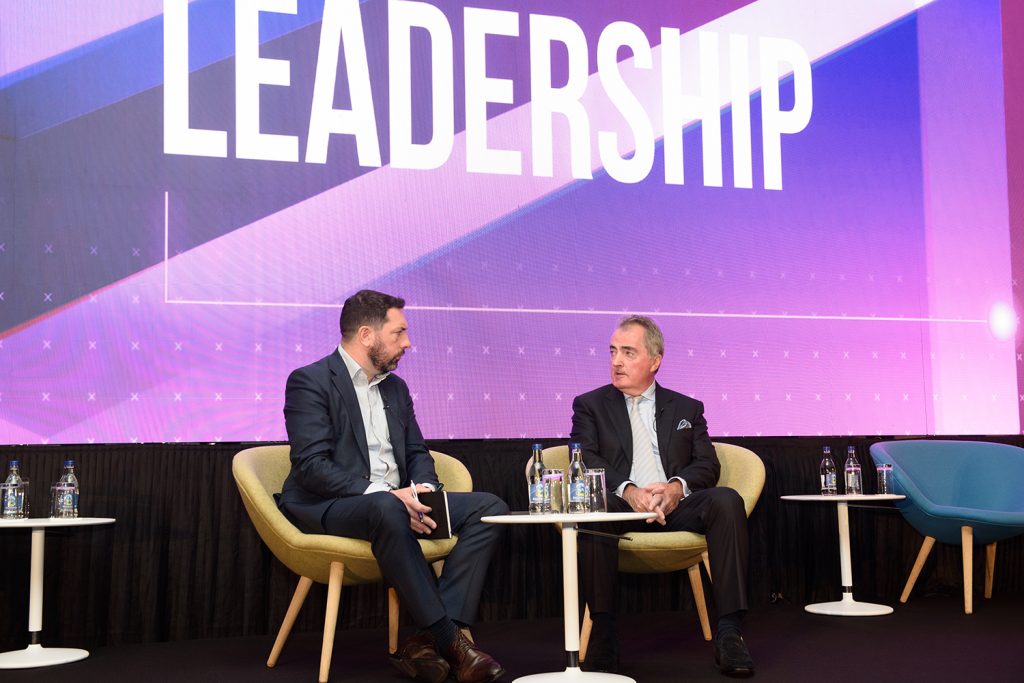
Although Ireland’s infrastructure challenge is often described in terms of housing, water, energy and transport, the lively and provocative discussion at IMI’s National Leadership Summit pointed to a potentially deeper issue: whether institutions can plan, coordinate and deliver across organisational boundaries.
In Part One of Rewiring Ireland, Sean O’Driscoll argued that Ireland must reform the machinery of government and change how the public system approaches risk. The Summit’s CEO panel picked up that challenge and examined what successful delivery requires in practice.
Moderated by broadcaster and journalist Áine Kerr, the panel brought together Hilary O’Meara, Country Managing Director at Accenture; Stephen Kent, CEO of CIÉ Group; Niall Gleeson, CEO of Uisce Éireann; and Alice Charles, Director of Cities, Planning and Design at Arup.
Their perspectives varied at points, but the discussion repeatedly returned to the same requirements: clearer priorities, formal coordination, a credible project pipeline, sustained funding, and the skills and leadership capacity to turn plans into delivery.
From national ambition to delivery
Hilary O’Meara began by arguing that Ireland’s infrastructure difficulties should be considered alongside the country’s wider economic and institutional strengths.
She said businesses, government and academia had faced Covid-19, wars, geopolitical instability, changes in tariffs, pressure across the technology sector and the rapid development of artificial intelligence.
Despite those pressures, Ireland had maintained near-full employment, economic growth, a healthy democracy and a strong international standing.
“What I get a little bit frustrated about is the fact that we’re always focused on what we’re doing wrong and what we’re doing badly,” she said.
O’Meara said Ireland should acknowledge its achievements while directly addressing the areas in which it was underperforming.
She supported O’Driscoll’s argument that the operating model of government needed to change. Accenture had undergone numerous operating-model changes during her career, she said, while the fundamental structure of the State had remained largely unchanged.
The challenge was now one of execution and joined-up government. Departments and organisations need a common purpose, aligned timelines, funding and priorities if they are to deliver complex national projects, she said.
O’Meara argued that the Taskforce had demonstrated what a more coordinated approach could achieve and that similar discipline was required in other areas of public policy.
Stephen Kent described how the scale of the challenge facing public transport had changed.
When he entered the public sector following the financial crisis, the focus was on achieving annual passenger growth of approximately 2 per cent. CIÉ operating companies have more recently had to manage periods of growth of approximately 20 per cent, placing pressure on recruitment, training, reliability and customer service.
Kent distinguished between the responsibilities of individual transport operators and the wider role of CIÉ Group.
Operating companies such as Iarnród Éireann must focus closely on the customer experience. At group level, however, CIÉ must also consider the wider needs of citizens, the use of state-owned land and how its resources and expertise can support national objectives.
Kent said alliances between public bodies should be embedded in formal systems rather than depend on relationships between individual leaders.
Without coordination, organisations risk duplicating expertise or developing resources already available elsewhere in the State.
Niall Gleeson described the Accelerating Infrastructure Taskforce as a “game changer” that had brought agencies together and established a stronger foundation for delivery.
He said utilities and semi-state organisations had traditionally been highly protective of their own assets. When another organisation submitted a planning application, each body could raise concerns to protect its infrastructure, adding complexity to the planning process.
Gleeson suggested that many of those concerns could instead be resolved directly through agreements between the organisations involved.
“Look after my assets, I look after yours,” he said.
Where concerns still needed to be included in a planning submission, organisations could make clear that they expected to resolve them during construction rather than asking planners to settle every operational issue in advance.
The Taskforce had also created space for delivery bodies and regulators to discuss processes without compromising the independence or substance of regulatory decisions.
Gleeson said environmental and other regulators still had to fulfil their statutory responsibilities. The objective was to improve the process and secure decisions more quickly, rather than avoid scrutiny.
Governance, expertise and international credibility
Alice Charles compared Ireland’s approach with governance and infrastructure delivery in Denmark and other European countries.
Charles had spent the previous two days in Copenhagen, where Arup is involved in the development of a fifth metro line and the regeneration of the city’s port area.
She said Copenhagen had also convened European cities, state development agencies, investors and the European Investment Bank to discuss urban development, infrastructure, regeneration and housing. Ireland was not represented at those discussions.
Charles identified six areas requiring attention: governance, expertise, vision, a credible project pipeline, committed funding and delivery.
She said approximately 66 per cent of public spending in Denmark occurred at local-government level, compared with approximately 4 per cent in Ireland.
Ireland was not giving local government the authority or resources required to deliver infrastructure and public services, she argued.
Charles also called for greater specialist expertise within the civil service. Ireland and the UK had traditionally relied on a generalist civil-service model, while other European administrations allowed specialists in areas such as infrastructure finance, transport and planning to build careers within those fields.
She referred to Copenhagen’s City Architect, who had moved into public service following a successful private-sector career and was responsible for helping to establish a long-term vision for the city.
Arup is currently working on a masterplan for Madrid extending to 2050. Charles said planning functions in many European cities concentrated on developing strategies, masterplans and long-term visions rather than primarily processing individual planning applications.
Ireland’s planning system had become increasingly legal and adversarial, she argued.
Charles said Ireland needed a clear pipeline of projects. Copenhagen was developing its fifth metro line while Ireland was still discussing its first.
She also called for committed multi-year funding and greater use of the European Investment Bank for both technical assistance and lending.
The final requirement was delivery.
“What we’re not known for amongst the contracting world internationally is delivery,” Charles said.
Ireland will need to draw on contractors from countries including Spain, France, Sweden and Germany to deliver its planned infrastructure programme. Those companies currently lacked confidence that the Irish projects being discussed would proceed.
“Right now they don’t believe us because too many times we have plans and we put them on the shelves,” she said. “We need to get serious about delivery.”
Building collaboration into the system
O’Meara agreed delivery required a clear vision, defined priorities and choices about where the country would focus its resources.
The strategy then had to be supported by cross-government execution and confidence among the people responsible for making decisions.
She said public officials needed “air cover” when making reasonable decisions involving risk. Business and academia also had responsibilities and could not treat infrastructure delivery as solely a government problem.
The discussion extended from physical infrastructure to the skills required by the future economy.
O’Meara said AI was already affecting Irish businesses, but its eventual level of disruption was not yet fully understood.
Organisations would require deep specialists alongside generalists capable of coordinating their work and turning specialist knowledge into execution.
She argued that Ireland needed a “skills infrastructure” alongside its physical infrastructure.
Kent provided examples of the interdependencies encountered when CIÉ companies attempted to expand services.
The introduction of an electric town-bus network in Athlone required coordination with ESB to secure an electricity connection. Expanding bus services created a demand for drivers and mechanics that could not be met through existing recruitment and training systems.
CIÉ had to work with organisations including SOLAS and the Road Safety Authority to address training and licensing constraints. Those bodies also needed additional resources to manage the volume of demand.
Kent said major initiatives should be communicated across the relevant organisations at an early stage so that interdependencies could be identified and addressed before they became obstacles.
Too often, progress depended on a chief executive contacting another senior leader personally when a project had already reached an impasse.
O’Meara said Kent’s example demonstrated what could be unlocked if organisations shared a common purpose and understood one another’s plans in advance.
Gleeson agreed that cooperation between chief executives already occurred but said formal structures were needed to make it systematic.
He pointed to the development of Uisce Éireann as evidence that the State could undertake major organisational transformation.
Responsibility for water services had previously been spread across 31 local authorities. Bringing those services together under a single national authority allowed the organisation to plan water infrastructure for the country as a whole and respond consistently to new drinking-water and wastewater requirements.
Gleeson said the organisation had been “shell-shocked” when he became chief executive following sustained public and political criticism. Rebuilding confidence among employees was necessary before the organisation could develop stronger relationships with other bodies.
The creation of a single national water authority had attracted interest from international delegations, he said, because water services in many countries remained divided across municipal structures.
Placemaking and long-term planning
Charles welcomed the progress made through the Taskforce and the establishment of a housing activation office but warned that coordination could not be limited to physical infrastructure.
She used development near Dunboyne as an example. Approximately 2,000 homes were being built while local primary and secondary schools, childcare services and healthcare facilities were already at capacity.
Charles said European cities increasingly approached development through placemaking, considering in advance where schools, crèches, shops, parks, transport and other services would be located.
“If you focus on housing units, just physical infrastructure, you don’t create quality places,” she said.
She called for the departments responsible for education, health and sport to become more closely involved in infrastructure and housing planning.
Charles also supported O’Driscoll’s proposal for a dedicated Minister for Local Government.
Kent discussed the potential redevelopment of Heuston and Connolly stations as examples of the balance between meeting immediate operational needs and planning infrastructure intended to last for generations.
He said Heuston could provide a better interchange between bus and rail services, reducing the need for passengers to cross busy roads and creating a more integrated transport experience.
Developing that vision would require CIÉ to work with the National Transport Authority, Dublin City Council, the Land Development Agency, government departments and the relevant boards and funding bodies.
A chief executive may have an ambition for a project but is not a free agent, Kent said. Business cases, governance requirements and the responsibilities of partner organisations must all be addressed.
Bringing that coalition together was difficult and there was no single manual explaining how it should be done.
“We’re kind of learning as we go,” he said.
Kent suggested that the pathways developed for major projects should be documented so that other leaders and organisations could learn from them.
Building the skills required for delivery
The panel then returned to workforce capability.
O’Meara said future Irish economic growth would increasingly depend on productivity, supported by skills and technology.
Ireland retained a strong international reputation for the quality, education and emotional intelligence of its workforce. That advantage could be lost if businesses did not begin reskilling people for the changes being driven by AI and other technologies.
“We’ve talked a lot about government here and the civil servants, but actually business has a huge job to do,” she said. “We employ most of the people in the country. We have to reskill.”
Universities, education and training boards and apprenticeship providers also needed to adapt, she said.
Ireland would require data, technology and AI capabilities alongside the engineering, construction and operational skills needed to deliver its infrastructure programme.
O’Meara called for a coordinated skills programme to develop in parallel with the physical infrastructure pipeline.
Gleeson outlined how Uisce Éireann had approached the cultural and workforce elements of its own transformation.
Employees joining the organisation came from local authorities, semi-state organisations and the private sector. Creating a shared vision, purpose and set of behaviours was central to bringing those groups together.
The organisation’s common purpose was the provision of safe water and wastewater services, which Gleeson described as fundamental to the functioning of society.
He said an operator with 20 years of experience running a rural treatment plant should receive the same respect as a water specialist with a doctorate.
Bringing practical experience and specialist knowledge together allowed problems to be solved more quickly and enabled both groups to learn from each other.
An all-island plan and national delivery agency
At the conclusion of the panel, Charles called for an all-island infrastructure plan extending to 2050.
She said Dublin Airport functioned as an international gateway for people across the island, requiring transport connections from every region.
Energy infrastructure should also be considered on an all-island basis, she argued, particularly in relation to offshore wind, electricity-grid capacity and the ability to attract foreign investment.
Charles described the Dublin–Belfast corridor as the economic heart of the island.
Gleeson supported the proposal and recalled his experience leading Alstom Ireland during the original Metro North tender in 2008. The company had spent €15 million preparing a bid before the project collapsed during the international financial crisis.
Ireland had moved slowly to rebuild its infrastructure programme following that crisis, he said.
“We’ve done nothing for the last 20 years and now we’re doing everything, everywhere, all at once,” he said.
Gleeson called for greater public support for major projects and proposed a national framework, potentially supported by a state infrastructure agency, to coordinate delivery.
He suggested that the Accelerating Infrastructure Taskforce could eventually develop into such a structure.
Ireland also needed to communicate a credible pipeline to the international market and make clear that it required external expertise to deliver it.
“We need to go out to the world and say, yes, we are building all these projects,” he said. “We’re going to deliver and we need your help to do them.”
O’Meara concluded by returning to the responsibility of business leaders.
She said leaders should focus on the areas within their own control and bring courage, confidence and clear execution plans to their organisations.
She also questioned whether middle managers who had developed during the remote-working conditions of Covid-19 had received sufficient opportunities to build their leadership skills.
O’Meara said she intended to consider how leadership development could be extended more deeply through her own organisation.
Her final message was one of “courage, ambition and leadership”.
Kent closed by describing senior leaders as temporary stewards of national organisations and assets. Their responsibilities extended beyond their own tenure and organisational boundaries, he said.
“We are only in these roles for a while, and things are bigger than me,” he said.
Conclusion
Taken together, the discussion suggested that Ireland does not necessarily lack ambition, expertise or capable institutions. However, connecting those strengths through systems that enable organisations to plan, decide and deliver together is a different challenge.
Part One considered how the machinery of government might be rewired, while the panel showed that structural reform is only one part of the challenge. Delivery will also depend on leaders sharing plans before they conflict, identifying dependencies early, giving decision-makers appropriate support when taking reasonable risks and building capabilities that extend beyond individual organisations.
The test, arguably, isn’t whether Ireland can produce another convincing plan. It is how the country can create a system in which capable organisations consistently deliver together—and can continue to do so after the individual leaders who built the relationships have moved on.
Turn ambition into delivery
Delivering complex plans means understanding dependencies, making clear choices and leading beyond your own function. IMI’s Executive Leadership Accelerator helps senior leaders strengthen these capabilities and apply them to live organisational challenges.